The Science
The Science
of Sound.
Where ancient instruments meet modern acoustics.
A gong is not just heard — it is measured, tuned, and felt. Here is the physics and mathematics behind why sound moves us the way it does.
01 — The Harmonic Series
Many notes within one.
Every tone you hear is not one note but many. When an instrument vibrates, it produces a fundamental frequency and a series of overtones at whole-number multiples of it — 2x, 3x, 4x — called the harmonic series.
The specific blend of these harmonics is why a gong's voice feels so vast: unlike a piano string, a gong vibrates with hundreds of interlocking harmonics and inharmonic partials at once, creating that shimmering, oceanic wash of sound.

02 — Brainwave Entrainment
The frequency following response.
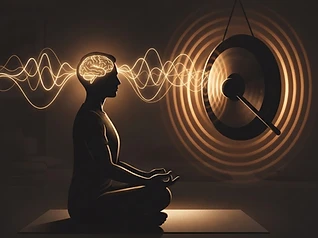
The brain has a remarkable tendency to synchronize its own electrical rhythms with rhythmic stimuli from the outside world — a phenomenon called the frequency following response.
When you listen to steady, rhythmic tones like drumming or gong pulses, your brainwaves begin to align with them. Sound baths use this to gently guide the brain from busy beta waves down into the slower alpha and theta states associated with meditation, deep relaxation, and vivid imagery.

03 — The Mathematics of Tuning
Mathematics made audible.
Tuning is mathematics made audible. An octave is a 2:1 frequency ratio; a perfect fifth is 3:2.
For centuries, tuning systems were built from whole-number ratios like these, and planetary tuning goes further — translating the orbital periods of planets into audible frequencies using the same math.
Our instruments are tuned so these ratios line up, which is why combinations of tones can feel consonant, settled, and whole.
04 — Vector Scope Analysis
A visual proof of harmony.
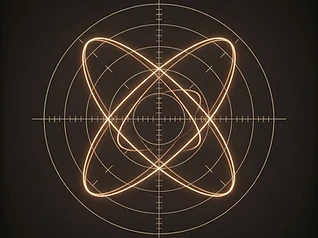
On a vector scope, two waveforms are plotted against each other — one driving horizontal motion, the other vertical.
When the frequencies relate in simple ratios, the trace locks into a closed, looping figure called a Lissajous curve: a 3:2 ratio draws a beautiful knot, 1:1 draws a perfect circle. It is a direct visual proof of the harmony inside the sound — and a tool we can use to see how two tones relate.

05 — Amplitude Modulation
The breath inside the tone.
Amplitude modulation is the slow rising and falling of a sound's loudness. Gong tones don't just sit — they pulse, breathing in slow envelopes.
Those slow fluctuations (often around the rate of a resting breath) are thought to invite the nervous system to entrain with the sound, easing the body from vigilance into rest. You can hear it as the wave-like swell of a gong wash.